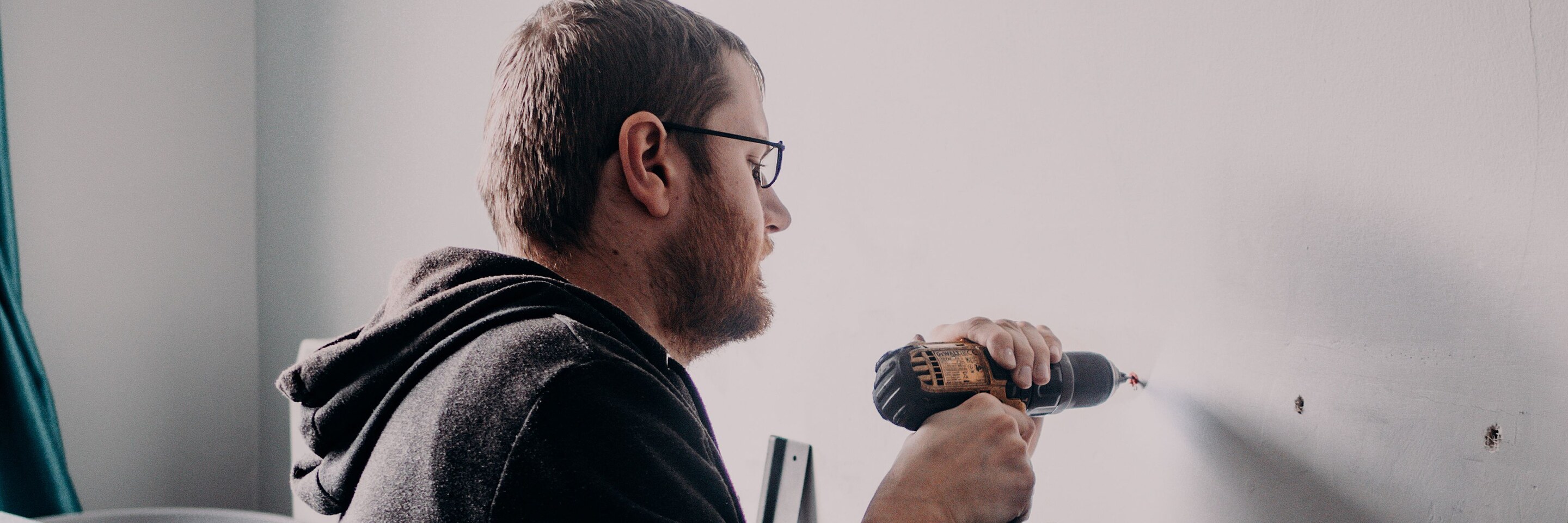

What kind of drill do you actually need for NYC walls?
You bought a $20 floating shelf. Three hours later you're standing in front of a smoking hole, the shelf is still on the floor, and you've learned that "drywall anchor" isn't a magic word. NYC apartments have weird walls. Here's what you actually need to hang things in them.
Quick answer
NYC apartments have four common wall types: modern drywall, plaster over wood lath (most pre-war buildings), solid brick (older buildings and exposed walls), and concrete or cinder block (some newer construction). A standard cordless drill handles drywall easily and most plaster with the right bit. For brick or concrete, you need a hammer drill — a regular drill will overheat and burn the bit out. For old NYC pre-war brick (which is often crumbly), a rotary hammer with masonry bits is the upgrade if you're doing more than a couple of holes. Most apartment dwellers don't need to own any of these — a cordless drill rents for around $35 for 48 hours from a neighbor on Green Gooding, a hammer drill for slightly more.
You're trying to hang a TV mount, a shelf, a curtain rod, or a picture frame. The hole you drilled crumbled outward. The anchor is spinning. The bit smells like burnt plastic. You probably have the wrong drill, or the right drill with the wrong bit, or both. Across the five boroughs, NYC apartments are a museum of construction eras — pre-war brick from the 1920s next door to converted lofts next door to brand-new condos — and each kind of wall needs different equipment. Here's the field guide.
Step one — figure out what your wall is made of
This is the part most online guides skip. Before picking a drill, you need to know what you're drilling into. Four types cover most NYC apartments:
- Modern drywall (gypsum board). Common in renovated apartments, post-1980 buildings, and most new construction. Drywall is soft — your knuckle bounces off with a hollow knock, and a thumbtack pushes in by hand. White dust if you scratch it.
- Plaster over wood lath. Most pre-war apartments in Brooklyn brownstones, Upper West Side classics, and Astoria walk-ups. Plaster is hard and brittle. Your knuckle hits something rock-solid, but if you scrape, you'll see white-gray crumbly material rather than smooth chalk. Drilling produces a crumbly powder and sometimes chunks.
- Solid brick. Common in older buildings, especially the wall between your apartment and the next one, or any exposed-brick wall. Knock and you hear a dull "thock," no echo. Often these have been painted over with many coats. Hard, dense, doesn't crumble easily.
- Concrete or cinder block. Some newer construction and basements. Knock and you hear nothing — it's solid all the way through. Very hard, very dense, the most demanding to drill.
Quick test: tap your knuckle in three spots across the wall.
- Echo + soft = drywall
- No echo + hard but crumbly when scratched = plaster over lath
- No echo + dense + nothing crumbles = brick or concrete (cinder block usually has a slightly different ring than brick)
When in doubt, drill a very shallow test hole in a hidden spot — behind a picture, low in a corner. The dust color and crumb size tells you everything.
Cordless drill — what it can and can't do
A standard cordless drill (12V or 18/20V) is what most people picture when they hear "drill." It spins. That's all it does — pure rotational force.
Great for:
- Drywall (any brand, any bit, easy as butter)
- Soft wood, light hardwood
- Metal up to ¼"
- Driving screws (most cordless drills are also drivers)
- Some plaster, IF the plaster is firm and you use a sharp masonry bit and let the bit do the work — don't push
Bad for:
- Brick — bit overheats, glazes over, stops cutting within 30 seconds
- Concrete — same as brick, plus you'll smoke the motor on a real concrete pour
- Old crumbly pre-war plaster (it'll just create a wide crumbly hole, no clean edges)
If you're hanging picture frames in a renovated apartment with drywall, a cordless drill is all you need. For most NYC apartments under 25 years old, this is the answer.
Hammer drill — when you actually need one
A hammer drill spins AND pulses forward at the same time (thousands of small hammer blows per minute). The hammering breaks the wall material; the rotation clears the dust. Together they punch through hard masonry without burning out the bit.
Great for:
- Solid brick (single course or face brick — fine for most apartment walls)
- Painted-over old brick
- Hard plaster (firm pre-war stuff that a regular drill won't touch)
- Light concrete
- Brand-new shelves, TV mounts, curtain rods on a brick wall
Bad for:
- Drywall (overkill — you'll punch a too-large hole, and your anchor won't grip)
- Tile (use a regular drill with a tile bit, slow and steady)
- Anywhere precision matters more than power
Most home hammer drills are "combi-drills" — you toggle hammer mode on and off. So a combi-drill is a cordless drill AND a hammer drill in one body. If you're going to own only one drill in NYC, a combi-drill is the right one.
Rotary hammer — when you really need one
A rotary hammer is the bigger, meaner cousin of the hammer drill. The hammering action is much more powerful — driven by a piston, not a clutch — and it uses SDS-style bits instead of regular round-shank bits.
Great for:
- Old crumbly NYC pre-war brick where you need 6+ holes
- Solid concrete pour
- Cinder block
- Anchor bolts into masonry for heavy items (a TV mount on brick, a wall-mounted bike rack, a kitchen cabinet on a brick wall)
Bad for:
- Everything a regular drill or combi-drill already does — way too much tool for drywall, plaster, or wood
A rotary hammer is overkill for hanging a single shelf. But if you're mounting heavy items (60+ pounds) on an old brick wall, or you're drilling more than four or five holes into brick or concrete in one session, the rotary hammer will save you 30 minutes of struggle and a smoked bit.
The four NYC scenarios
| Scenario | Wall type | Right drill | Bit type |
|---|---|---|---|
| Picture frame in a renovated 2010s condo | Drywall | Cordless drill | Standard bit + drywall anchor |
| TV mount in a 1920s pre-war brownstone | Plaster over lath OR brick (test first) | Combi-drill (hammer mode if brick) | Masonry bit |
| Curtain rod in a Brooklyn loft with exposed brick | Solid brick | Hammer drill | Masonry bit |
| Floating shelves in a 1960s Mitchell-Lama | Often hollow cinder block or plaster | Hammer drill | Masonry bit + heavy-duty anchor |
| Heavy mirror in a pre-war plaster wall | Plaster over lath | Cordless drill, low speed, sharp bit | Masonry bit (sharper than a wood bit) |
| Wall-mounted bike rack on brick | Solid or pre-war brick | Rotary hammer | SDS masonry bit |
| Anchor bolt into a concrete column | Concrete | Rotary hammer | SDS bit |
The bit matters as much as the tool
The wrong bit will defeat the right drill. Three things to know:
| Bit type | What it looks like | Use it for |
|---|---|---|
| Wood bit | Sharp point in the middle, spiral flutes | Wood only |
| Masonry bit | Chunky carbide tip, looks duller — it breaks and clears rather than cuts | Brick, concrete, plaster |
| Tile bit | Spear-shaped carbide point; needs slow speed + a steady stream of water to cool | Tile only |
Using a wood bit on plaster will give you a crumbly mess. Using a masonry bit on drywall will work, just very slowly. The masonry bit is the most versatile if you have one — it'll handle plaster, brick, concrete, and most other masonry. Most home centers sell a small set for under $15.
The NYC apartment math — rent or buy?
A decent cordless drill runs $80–$150. A combi-drill (cordless + hammer) runs $130–$250. A rotary hammer runs $200–$400. A full set of bits adds another $25–$50.
For most NYC apartments, you'll drill into walls maybe 5–15 times over the entire time you live there — hanging a TV mount, a few shelves, a curtain rod, an art piece. That's it.
The cost-per-use math:
- Buying a combi-drill: $200, used 10 times in 5 years = $20 per use, plus storage cost (a drill case is the size of a shoebox, lives at the back of a closet, taunts you).
- Renting a cordless drill from a neighbor: around $35 for 48 hours, only when you need it.
- Renting a combi-drill or rotary hammer: similar range, varies by listing — owners set their own prices.
If you're a serious DIYer or own your apartment and constantly upgrade things, buying makes sense. For most renters and casual home-improvement people, browsing the tools & DIY category and renting beats owning.
When to rent a drill from a neighbor
If you're hanging more than two things this weekend or you've already started a project and realized the wall isn't what you thought, renting beats buying every time. Across the five boroughs, neighbors on Green Gooding rent cordless drills, hammer drills, and rotary hammers — often with a starter bit set included. Pickup is from a neighbor in your borough, and some offer same-day pickup if you message them in the morning.
Got a project this weekend?
Browse drills and DIY tools on Green Gooding →
Pickup from a neighbor in Brooklyn, Manhattan, Queens, the Bronx, or Staten Island · around $35 for 48 hours · some neighbors offer same-day pickup.
The bigger picture
NYC apartments aren't sized for tool collections. Drills, drivers, hammer drills, oscillating multi-tools, circular saws — the kind of stuff a homeowner in the suburbs leaves in a garage — borrow them from a neighbor across the five boroughs, do the project, return them. Your closet stays usable, and the wall actually holds the shelf.
🔧 Need a drill this weekend?
Find a cordless drill, hammer drill, or rotary hammer near you across the five boroughs — around $35 for 48 hours, some neighbors offer same-day pickup.
Key takeaways
- Figure out your wall first. Drywall, plaster, brick, or concrete — each one needs a different drill (or at least a different bit).
- Cordless drill for drywall and most plaster. Hammer drill for brick and hard plaster. Rotary hammer for old NYC pre-war brick when you have 6+ holes or heavy mounts.
- A combi-drill is the one-tool answer for most NYC apartments — it's a cordless drill AND a hammer drill in one body.
- The bit matters as much as the tool. Masonry bits handle plaster, brick, and concrete. Don't try to use a wood bit on anything but wood.
- For most renters in NYC, renting beats buying. $35 for the weekend, no closet eaten by a tool case.
Skip the hardware-store haul
Find a drill near you on Green Gooding →
Cordless drills, combi-drills, and rotary hammers from neighbors across the five boroughs — often with a starter bit set included.
Frequently asked questions
Can I use a regular drill on a brick wall?
For one or two small holes, you can try — but the bit will overheat and stop cutting quickly. For anything more than a single test hole, you'll need a hammer drill. Trying to muscle a regular drill through brick will smoke the motor and ruin the bit.
What's a combi-drill?
A combi-drill (or "combination drill" / "hammer drill driver") is a cordless drill with a hammer mode you can toggle on and off. It's a regular drill and a hammer drill in one body — for most NYC apartments, the one tool that handles everything from drywall to brick. Slightly heavier than a pure cordless drill, much lighter than a rotary hammer.
Do I need a hammer drill for plaster walls?
Usually not. Plaster over wood lath is hard but brittle, and a standard cordless drill with a sharp masonry bit at low speed will get through it. If the plaster is very old and rock-hard, or if you keep crumbling the surface, a hammer drill makes the job cleaner.
What's the difference between a hammer drill and a rotary hammer?
Both pulse forward while spinning, but a rotary hammer uses a much more powerful piston-driven mechanism and SDS-style bits. A hammer drill is good for occasional brick and masonry. A rotary hammer is for heavy or repeated masonry work — concrete, multiple holes in old brick, anchor bolts.
Can I just use a screwdriver and a nail for picture frames?
For small picture frames on drywall, often yes — a finishing nail or a thumbtack-style hanger works fine without a drill at all. For anything heavier than a few pounds, you'll want to drill a pilot hole and use a wall anchor.
Where can I rent a drill in NYC?
Green Gooding lists cordless drills, hammer drills, and rotary hammers from neighbors across the five boroughs. Browse DIY rentals → — usually around $35 for 48 hours, owners set their own prices. Some neighbors offer same-day pickup if you message them in the morning.
What kind of anchor do I need for plaster walls?
For light items (under 5 pounds), plastic expansion anchors work. For medium (5–20 pounds), use molly bolts or toggle bolts that grip the back of the plaster — these spread the load across the lath behind. For heavy items (20+ pounds), find a stud with a stud finder, or upgrade to heavy-duty toggle bolts rated for the weight.